
Refrigerator Not Cooling but Freezer Works? 8 Checks, Easiest First
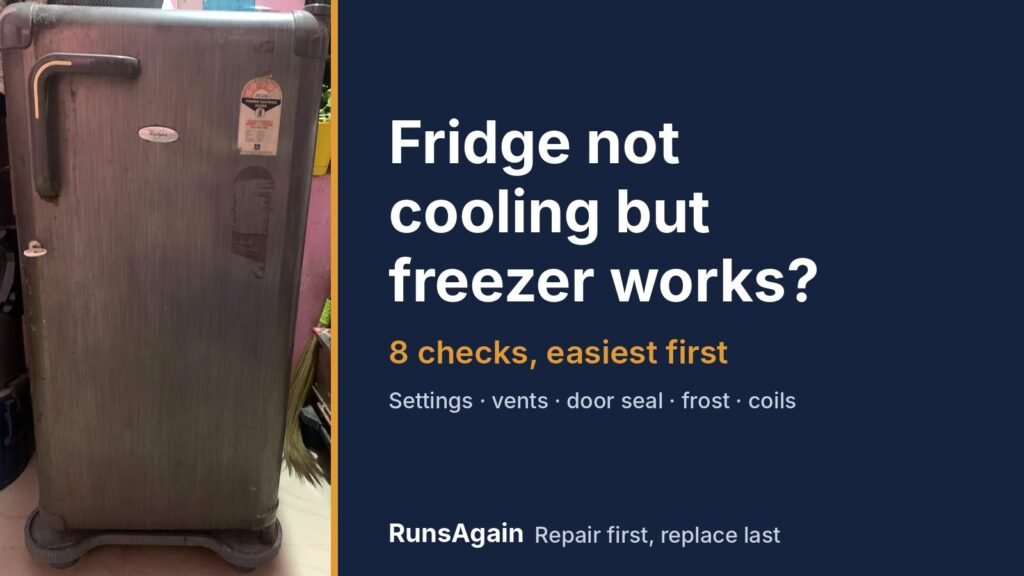
Your freezer is still making ice, but the fridge section is warm: the milk isn’t cold and leftovers spoil early. In most fridges that split has a simple reason. The cold air is made in the freezer and blown into the fridge section through vents, so when the freezer is cold and the fridge isn’t, that air isn’t getting through. This guide works through eight checks from easiest to hardest, so you can stop as soon as the fridge cools again. Most need no tools.
Quick answer: When the freezer is cold but the fridge isn’t, check the temperature controls first, then make sure food isn’t blocking the air vents and the door seals tightly. Give the fridge 24 hours after any change. Clean dusty condenser coils, and on a single-door or compact fridge, defrost the freezer compartment once the frost is about 1/4 inch thick. If the back wall of the freezer is covered in frost, or the fridge stays above 40°F after these checks, call a technician.
The checks follow Whirlpool’s and GE Appliances’ own support pages. They apply to top-freezer, bottom-freezer, side-by-side and French door fridges, and to single-door and compact fridges with a small freezer compartment inside. Where the two kinds differ, the check says so.
Before you start: Put an appliance thermometer on the middle shelf and read it after a few hours. The FDA says the fridge should be at 40°F or below and the freezer at 0°F. If the fridge has been above 40°F for more than 2 hours, perishable food may not be safe, and if you aren’t sure how long it’s been warm, throw it out (FDA). Move what you can to a cooler with ice while you work. Unplug the fridge before you clean the coils or defrost it.
The 8 checks at a glance
- Check the controls and the cooling setting
- Give it time to cool
- Clear the air vents
- Test the door seal
- Check the room it’s in
- Clean the condenser coils
- Look for frost on the freezer’s back wall
- Single-door or compact fridge? Defrost the freezer
After each check, wait a few hours and read the thermometer again. After a control change, Whirlpool says to wait at least 24 hours before you judge the result or change it again (Whirlpool).
Why the freezer stays cold when the fridge doesn’t
Most full-size fridges have one cooling system for both sections. Whirlpool explains that cold air is made in the freezer and pushed into the fresh food section through vents, then returns to the cooling coils (Whirlpool). GE describes the same design: the freezer supplies cold air to both compartments through a damper (GE Appliances). So anything that stops that air moving, from a crowded shelf to frost on the coils, leaves the freezer cold and the fridge warm.
Single-door fridges and most compact fridges work differently. The small freezer compartment at the top is the cold surface for the whole cabinet, and it isn’t frost-free: GE says the freezer in its compact fridges has to be defrosted by hand (GE Appliances). That kind has its own check (Check 8).
Check 1: Check the controls and the cooling setting
Start with the settings, because they’re the easiest thing to fix. Whirlpool’s own checklist starts here (Whirlpool):
- Cooling turned off: some fridges have a setting that turns cooling off. Whirlpool says some need turning back on after a power outage or surge, and that it can be switched off by accident during cleaning.
- Demo or showroom mode: on some models the lights work but nothing cools. Your Use and Care Guide shows how to turn it off (Whirlpool).
- Controls too warm: controls are preset at the factory to a mid setting. GE suggests keeping the fridge around 37°F and the freezer around 0°F (GE Appliances). To make the fridge colder, move its control one setting colder, then wait 24 hours.
- Airflow control: on some Whirlpool top-freezer fridges, a control on the back wall of the freezer sets how much cold air goes to the fridge. Set it to the Recommended setting.
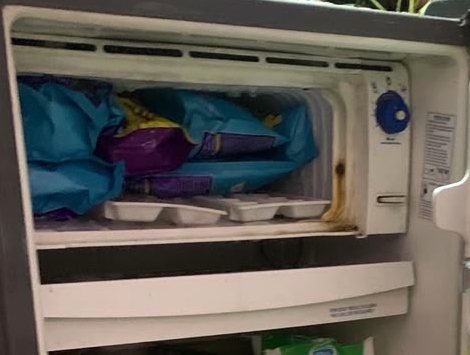
Dials differ, so check which way is colder before you turn one. On the numbered knobs inside some GE bottom-freezer fridges, 9 is the coldest and 0 turns cooling off (GE Appliances). On my own single-door Whirlpool, the dial sits inside the freezer compartment, right where you reach for the ice trays, so check it hasn’t been turned.
Check 2: Give it time to cool
Whirlpool says a newly installed fridge needs 24 hours to reach its temperature, and that a large load of food or drinks can take several hours to cool down (Whirlpool). A power cut has the same effect. Keep the doors shut so it can catch up.
Opening the door often also warms it. Whirlpool suggests taking out everything you need at once and closing the door straight away (Whirlpool).
Check 3: Clear the air vents
On a fridge with one cooling system, this is the check most likely to fix it. Whirlpool says that when bulky items block the return air vents, the airflow is broken and the fridge compartment can warm up (Whirlpool).
- Find the vents in both the fridge and the freezer. Where they are depends on the model, so check your manual. On many GE side-by-sides, the vent into the fridge is on the left wall (GE Appliances).
- Move anything pushed against them, in both sections.
- Leave small gaps between containers and don’t stack items too high, so air can move around each shelf, as Whirlpool advises.
Don’t overfill the freezer either. Whirlpool notes that overpacking can cover the evaporator fan and block the airflow (Whirlpool).
Check 4: Test the door seal
A gap in the door gasket lets warm, damp air in. Whirlpool’s test: close the door on a piece of paper, then tug it. If it slides out with little resistance, the gasket may not be sealing (Whirlpool).
- Try the paper in several places around the door, including the hinge side.
- Make sure nothing is holding the door open, such as a package, a shelf or a tall bottle (GE Appliances).
- Wipe sticky spills off the gasket and the edge it closes against.
- A torn, cracked or flattened gasket needs replacing. Your manual or the manufacturer’s parts site lists the right one for your model.
Check 5: Check the room it’s in
Whirlpool designs its fridges for indoor use between 55°F and 110°F (13°C to 43°C), and warns that outside that range, such as in a garage, temperatures can drift (Whirlpool). In a hot room the motor also runs longer: Whirlpool says running 40% to 80% of the time is normal at average room temperatures, and more in warm weather (Whirlpool).
Keep the fridge out of direct sun and away from the oven, and leave the space around it that its installation instructions ask for.
Check 6: Clean the condenser coils
The condenser coils get rid of the heat the fridge pulls out of the food. Whirlpool says most homes don’t need routine coil cleaning, but in a greasy or dusty home, or with pets, the coils should be cleaned every 2 to 3 months. Some models don’t need it, and on others only a technician can reach them (Whirlpool).
- Unplug the fridge before you clean it (GE Appliances).
- Find the coils, usually on the back of the fridge or behind the grille at the bottom (Whirlpool).
- Vacuum off the dust with a crevice attachment. Go gently, because the coils and tubes bend easily.
- Plug it back in and give it a few hours before you check the temperature.
Check 7: Look for frost on the freezer’s back wall
This check is for frost-free fridges, which defrost themselves. Look at the back wall of the freezer, where the evaporator coils sit on most models (Whirlpool). A little frost on food packs is normal. A thick sheet of frost or ice over the back wall or the vents is not.
Thick frost blocks the coils and vents, so the freezer still feels cold while little air reaches the fridge. Whirlpool says a faulty defrost timer or heater can cause this frost build-up, and that’s a job for a technician: the coils sit behind a panel, next to wiring.
To keep the fridge going until the technician comes, you can empty it, unplug it and leave the doors open to melt the frost, with towels on the floor and a plastic scraper rather than anything sharp (GE Appliances). It’s only a stopgap: if the defrost system has failed, the frost will come back.
Check 8: Single-door or compact fridge? Defrost the freezer
Single-door fridges, like my own Whirlpool, and most compact fridges aren’t frost-free. GE says to defrost a manual-defrost fridge when the frost is 1/4 to 1/2 inch thick, and never to run one for more than six months without a full defrost (GE Appliances). If the freezer box is thick with ice and the fridge below is warm, defrost it before anything else. GE’s steps:
- Take everything out of the freezer compartment and keep frozen food in a cooler.
- Turn the temperature control to Off. Leave it off and the freezer door open: GE says an average build-up takes at least 2 hours to melt.
- As the frost softens, loosen it with a plastic scraper. Never use a knife or anything sharp or pointed: it can damage the refrigerating system.
- Sponge up the water as it collects, with towels on the floor in front of the fridge.
- Dry the compartment, set the control back to its usual setting, and let the fridge cool before you put the food back.
When to call a technician
Stop and call a technician if: the fridge stays above 40°F for 24 hours after these checks; thick frost keeps coming back on the freezer’s back wall; the fridge runs all the time but stays warm; you smell burning, or the cord or plug gets hot; or you see oily marks or hear hissing from the tubes. Don’t open sealed panels, cut or bend tubes, or touch the refrigerant system: that work needs a certified technician.
When you call, have the model and serial number ready, a note of which checks you’ve done, and the temperatures you measured. Your manual shows where the model label is.
Common questions
Why is my fridge warm but the freezer cold?
Usually because the cold air made in the freezer isn’t reaching the fridge section: blocked vents, a door that isn’t sealing, a control set too warm, or frost on the freezer coils. Work through Checks 1 to 7. On a single-door or compact fridge, thick ice in the freezer compartment is the usual cause (Check 8).
What temperature should my fridge be?
The FDA says 40°F or below for the fridge and 0°F for the freezer (FDA). GE suggests aiming for about 37°F in the fridge (GE Appliances).
Is the food in my fridge still safe?
The FDA says that if the fridge is still at or below 40°F, or the food has been above 40°F for 2 hours or less, it should be safe to eat. If you aren’t sure how long it’s been warm, throw it out (FDA).
How long does a fridge take to get cold again?
Up to 24 hours after it’s installed or after a control change, and several hours after you add a lot of food, according to Whirlpool (Whirlpool).
Should I turn the freezer colder to fix the fridge?
Not as a first step. Whirlpool says to check that the air vents aren’t blocked before you adjust the controls, and that setting them colder than recommended won’t cool the compartments any faster (Whirlpool). Which control sends cold air into the fridge also varies: on some GE models it’s the freezer control, on others the fresh food control (GE Appliances). Your manual says which.
Does a single-door fridge need defrosting?
Usually, yes. Unless the manual says it’s frost-free, the freezer compartment needs defrosting by hand from time to time. GE says compact fridges defrost the fresh food section on their own but need the freezer defrosted once the frost reaches 1/4 inch (GE Appliances). See Check 8.
Sources
- Not cooling: top freezer refrigerator (Whirlpool)
- Not cooling: freezer section (Whirlpool)
- Not cooling: both sections (Whirlpool)
- Refrigerator troubleshooting: how to fix a fridge (Whirlpool)
- 7 freezer problems and how to troubleshoot them (Whirlpool)
- What to do if your freezer is not freezing (Whirlpool)
- Refrigerator use and care guide W10422734 (Whirlpool)
- Refrigerator: adjusting temperature controls (GE Appliances)
- Bottom freezer refrigerator: temperature controls (GE Appliances)
- Side-by-side refrigerator: too cold, freezing food (GE Appliances)
- Compact refrigerator: partial automatic defrost (GE Appliances)
- Refrigerator: manual defrosting (GE Appliances)
- Top-mount no-frost refrigerator owner’s manual (GE Appliances)
- Refrigerator thermometers: cold facts about food safety (FDA)
Stuck on a step?
Ask below with your appliance's brand and model number, and we'll help if it's safe to fix at home.