
Garbage Disposal Not Working? 6 Fixes for a Hum, Jam or Clog
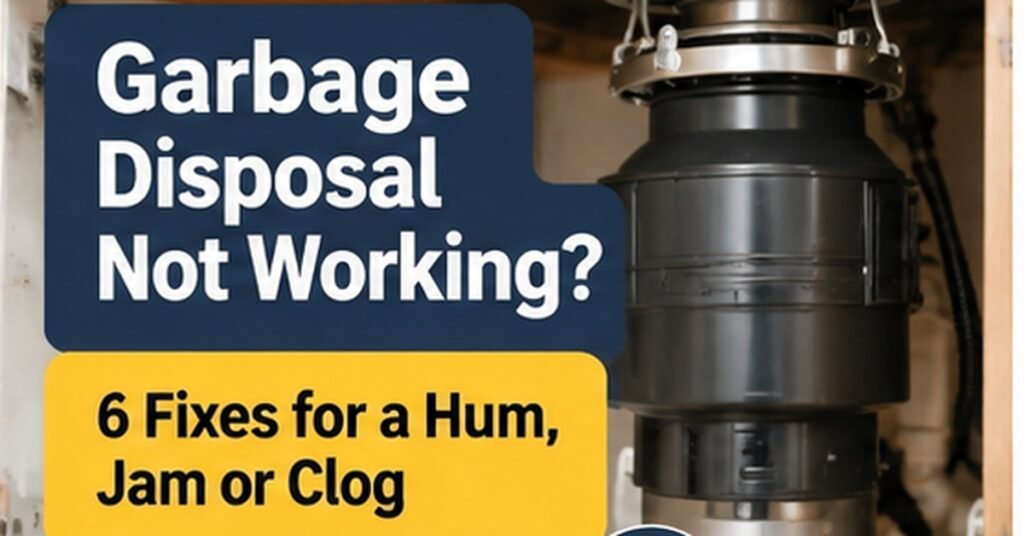
Your garbage disposal hums but doesn’t grind, or does nothing at all when you flip the switch, or the sink just sits full of dirty water. Over the holidays this is the classic kitchen emergency: Roto-Rooter says the day after Thanksgiving is the busiest day of the year for its plumbers, with about 50% more calls than an average Friday, mostly kitchen jobs (Roto-Rooter). Almost every disposal problem comes down to one of three things: a jam, a tripped overload or a clog. You can deal with all three from under the sink, and you never need to put a hand inside. This guide works through six fixes, easiest first.
Quick answer: If the disposal hums but won’t spin, it’s jammed: switch it off, turn the hex socket on the bottom with a 1/4-inch Allen wrench until it spins freely, then press the red reset button. If it’s silent, press the reset button and check the breaker. If it runs but the sink won’t drain, the clog is in the drain below it, so try a plunger. Never put your hand in the disposal, and never pour grease down it.
The fixes follow InSinkErator’s own support pages and suit most disposals with a hex socket in the middle of the bottom. A few InSinkErator models (EZ Connect, Builder Series, Amana and ES) work slightly differently, and Check 3 notes how. In the UK, the same appliance is often called a waste disposal unit.
Before you start: Make sure the disposal’s switch is off, and never put your hand into the disposal (InSinkErator). Before you clean it or reach under the sink with tools, disconnect the power: unplug the disposal if it plugs into an outlet (socket) under the sink, or switch off its breaker (InSinkErator). If the sink is full of water, bail it into a bucket first. You’ll need the wrench that came with the disposal (InSinkErator’s Jam Buster, a silver crank about four inches long) or a standard 1/4-inch Allen wrench, plus a flashlight and tongs or pliers.
The 6 fixes at a glance
- Silent? Press the reset button
- Still silent? Check the switch, plug and breaker
- Humming? Free the jam with the hex wrench
- Find and remove what jammed it
- Runs but won’t drain? Clear the clog
- Dishwasher backing up? Check the knockout plug
What is your disposal doing?
| What happens | Most likely cause | Start with |
|---|---|---|
| Silent, no hum at all | Tripped overload or no power | Checks 1 and 2 |
| Hums but doesn’t spin | Jammed grinding plate | Checks 3 and 4 |
| Starts, then stops while grinding | Jam or tripped overload | Checks 3 and 1 |
| Runs, but the sink drains slowly or not at all | Clog in the drain below the disposal | Check 5 |
| Dishwasher won’t drain, or its water backs up into the sink | Clogged disposal or a knockout plug left in | Checks 5 and 6 |
Check 1: Silent? Press the reset button
Disposals have an overload protector that cuts the motor when it jams or overheats. On InSinkErator units it’s a small, square red button on the bottom of the disposal. When it has tripped, it sits about a quarter inch (5 mm) lower than normal (InSinkErator).
- Turn the disposal’s switch off.
- Find the red button under the disposal and press it gently.
- If it won’t stay in place, the motor is still hot. InSinkErator says to wait ten minutes and try again.
- Turn on the cold water first, then the disposal.
If it trips again as soon as it starts, something is jamming it. Free the jam (Check 3) before you reset it again.
Check 2: Still silent? Check the switch, plug and breaker
If the reset button hadn’t tripped, or the disposal is still dead after a reset, follow the power back to its source:
- Wall switch: some kitchens have two or three switches near the sink. Make sure you’re using the one for the disposal.
- Plug: many disposals plug into an outlet under the sink, where bottles and boxes can knock the plug loose. Push it back in firmly. If that outlet, or one nearby, has Test and Reset buttons, press Reset.
- Breaker or fuse: if the motor still won’t run, InSinkErator says to check the service panel for tripped breakers or blown fuses (InSinkErator).
- Countertop push button: some disposals start from an air switch on the sink or counter instead of a wall switch. For InSinkErator’s EZ Connect units with a push-button air switch, the advice is to unplug the disposal and let it cool for up to 20 minutes.
If the disposal has power and the reset button is in, but it still makes no sound at all, see when to call a plumber.
Check 3: Humming? Free the jam with the hex wrench
A hum with no grinding means the motor has power but the grinding plate can’t turn. Switch it off straight away rather than leaving it humming, then free it from underneath. InSinkErator’s steps (InSinkErator):
- Find the hole in the center of the bottom of the disposal, facing the floor.
- Insert the wrench and work it back and forth in both directions, like a crank. You can use some force: InSinkErator says the wrench is designed to bend before the disposal is damaged.
- Keep going until the wrench turns freely through full circles in both directions.
- Press the red reset button (Check 1).
- Turn on the cold water first, then the disposal. If it jams again, repeat the wrench steps. It can take a few rounds.
Some InSinkErator models differ. On EZ Connect units, turn the wrench in the center hole one full revolution. On Builder Series, Amana and ES units, InSinkErator says to rotate the turntable from above with a wooden spoon, in either direction, to dislodge the object. Do that with the power disconnected.
Check 4: Find and remove what jammed it
Freeing the plate doesn’t remove the object, and it will jam again if it’s still in there. With the power still disconnected, shine a flashlight down the drain opening. InSinkErator says to look around the outer edge of the shredding disk, where the small teeth are, and lift out anything you find with tongs or pliers (InSinkErator). Anything hard that isn’t food, like a bottle cap or a piece of cutlery, is a likely culprit.
Then restore the power, run the cold water and test it.
Check 5: Runs but won’t drain? Clear the clog
If the disposal runs normally but water sits in the sink, the blockage is in the disposal’s drain or the pipes below it. InSinkErator says that if the disposal runs and you can see the water swirling in a whirlpool, you may have a clogged drain line (InSinkErator). Its steps, with the power disconnected while you clean:
- Clean the rubber baffle (the splash guard in the sink opening): scrub its underside and the inner lip of the grinding chamber with a scouring pad.
- Put the stopper in, fill the sink halfway with warm water and add 1/4 cup of baking soda.
- Restore the power. Turn the disposal on and pull the stopper out at the same time, so the rush of water flushes loose particles through.
If it’s still blocked, InSinkErator suggests a plunger:
- On a double sink, block the other drain with a stopper.
- Run about 4 inches (10 cm) of water into the sink.
- Press the plunger down slowly and gently, then pull it up quickly. Repeat several times.
- Once the water drains, run the water and the disposal for a minute or two.
InSinkErator’s steps use only baking soda and water. Skip chemical drain openers: if they don’t work, you’re left with a sink of harsh chemicals sitting over a clog that someone still has to open.
If other drains in the house are backing up too, the blockage is further down the line. Roto-Rooter ranks main sewer clogs second only to kitchen sinks and disposals among its Thanksgiving calls (Roto-Rooter), and that’s a job for a plumber.
Check 6: Dishwasher backing up? Check the knockout plug
Built-in dishwashers typically drain through the garbage disposal, so a clogged disposal can stop the dishwasher draining too (Whirlpool). Clear the disposal first (Checks 3 to 5).
If the disposal is new, check the knockout plug. It’s a small piece inside the disposal’s dishwasher inlet, and it has to be removed before the dishwasher drain hose is connected (InSinkErator). Whirlpool calls a plug left in place a common misdiagnosis for a clogged dishwasher. The plug sits recessed inside the inlet, so you can’t see it from the side. KitchenAid’s test: with the power off and the dishwasher hose disconnected (a bowl under it to catch water), push a pencil into the inlet. If it goes in about 3 inches, the plug has been removed (KitchenAid).
If the plug is still there, knock it out as the disposal’s installation guide shows, and fish the loose piece out of the disposal before you run it. When you reconnect the hose, check that its clamp is tight. For the dishwasher side of the problem, see dishwasher not draining.
Before the holiday: what not to put down it
Prevention is easier than any of the fixes. InSinkErator’s rules for every model (InSinkErator):
- No fats, oils or grease, ever. Pour turkey fat into a can or jar, let it set and put it in the trash.
- Cold water on first. Turn the cold water on before you start the disposal and let it run for a few seconds after grinding stops. InSinkErator says to avoid hot water while grinding, though draining hot water between grinding sessions is fine.
- Feed it gradually. Don’t pack the disposal full and then switch it on, and wait for the grinding to stop before you add more.
What else it can take depends on the model. InSinkErator lists potato peels, citrus rinds, coffee grounds, eggshells and rice as fine for all its series, but bones and fibrous foods like celery and corn cobs only for its top Advanced series. Roto-Rooter, which clears the clogs, is more cautious: it says to keep stringy, fibrous and starchy waste out of the disposal, naming poultry skins, celery, and fruit and potato peels (Roto-Rooter). On a day when you peel ten pounds of potatoes, put the peels in the trash (bin). And if it’s the oven that lets you down on the day, see oven not heating.
When to call a plumber
Stop and call a plumber if: the reset button won’t stay in after you’ve freed the jam and let the motor cool; the disposal still hums when the wrench turns freely; it makes no sound with the power on and the reset button in; it trips the breaker again; you smell burning; water drips from the body of the disposal itself; or other drains in the house back up too. Don’t open the disposal’s electrical cover or work on its wiring yourself.
When you call, have the brand and model from the label on the disposal ready, and say which fixes you’ve already tried.
Common questions
Why is my garbage disposal humming but not working?
It’s jammed. The motor is getting power, but something is stopping the grinding plate from turning. Switch it off, free the plate with the hex wrench from underneath, remove the object and press the reset button (Checks 3 and 4).
Where is the reset button on a garbage disposal?
On InSinkErator disposals it’s a small, square red button on the bottom of the unit. When it has tripped it sits about a quarter inch lower than usual (InSinkErator).
What size wrench fits a garbage disposal?
If you can’t find the wrench that came with it, InSinkErator says a standard 1/4-inch Allen wrench works (InSinkErator).
Can I use a plunger on a garbage disposal?
Yes. InSinkErator suggests one for a clog: block the other side of a double sink, run about 4 inches of water, push down slowly and pull up quickly, several times (InSinkErator). See Check 5.
Should I run hot or cold water with a garbage disposal?
Cold. InSinkErator says to run a moderate flow of cold water while grinding and to avoid hot water while grinding (InSinkErator).
Why won’t my dishwasher drain after a new garbage disposal was installed?
The knockout plug in the disposal’s dishwasher inlet is probably still in place. It blocks the dishwasher drain completely until it’s removed (Check 6).
Sources
- Fixing a jammed garbage disposal (InSinkErator)
- Fixing a clogged garbage disposal (InSinkErator)
- What can I grind? (InSinkErator)
- Garbage disposal leaking at the dishwasher inlet (InSinkErator)
- Newly installed dishwasher not draining (Whirlpool)
- Not draining: newly installed dishwasher (KitchenAid)
- Roto-Rooter prepares for the cloggiest day of the year (Roto-Rooter)
- Why the day after Thanksgiving is so busy for plumbers (Roto-Rooter)
Stuck on a step?
Ask below with your appliance's brand and model number, and we'll help if it's safe to fix at home.