
How to Clean a Washing Machine Filter (Drain Pump Filter)
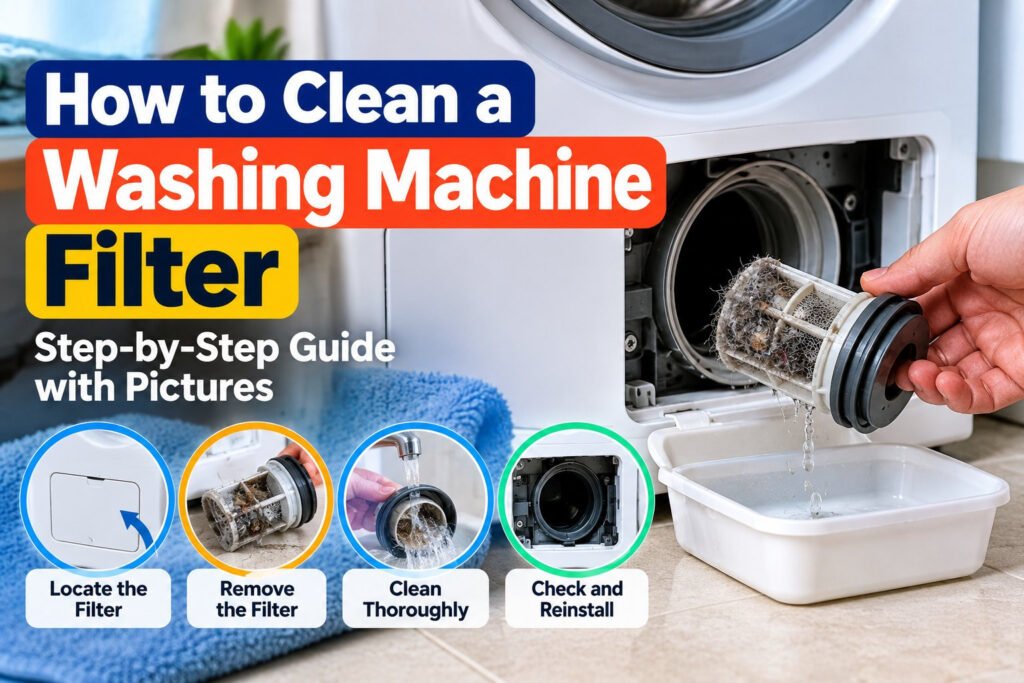
A washer that drains slowly, leaves water in the drum or starts to smell often has a clogged drain pump filter. This guide shows you how to clean a washing machine filter on a front-loader: drain the water, unscrew the filter, clear it and refit it so it doesn’t leak. You need no tools, apart from a coin on some models.
It also covers how often the big brands say to clean it, and the other filters your washer may have. For other problems, see all our washing machine fixes.
Before you start: Switch the washer off and unplug it from the mains (outlet). After a warm or hot wash, let it cool first: Bosch warns that the water coming out “may be very hot with a risk of scalding” (Bosch). Far more water comes out than most people expect, even when the drum looks empty, so lay down old towels and work slowly. Never force the filter or the door, and never tip the machine over.
Signs the filter needs cleaning
The filter sits in the path of the water leaving the drum. Beko says it protects the pump from objects such as coins and buttons (Beko). Lint and hair collect there too. When it clogs, you’ll usually notice one of these:
- Water left in the drum: clothes sit in a pool of water after the cycle (Bosch).
- Slow draining: Whirlpool says a blocked filter can cause slow or no draining (Whirlpool). Beko adds noises while draining and cycles that take longer than they should (Beko).
- A drain error code: on Samsung washers, nd, 5E, SE, 5C, SC and 1 5C mean water isn’t draining properly. Samsung’s fix list includes cleaning the pump filter (Samsung). Other brands use their own codes.
- A bad smell: Samsung says that if the pump filter is not cleaned regularly, “it will cause odors” (Samsung).
If the machine still won’t drain after you clean the filter, the blockage is elsewhere. Work through our guide to a washing machine not draining.
Where the drain pump filter is
Samsung says most front-loaders have a pump filter “on the front, near the bottom, behind a panel” (Samsung). It’s usually in one corner. LG’s is on the bottom-left (LG). Beko’s is on the bottom right-hand side (Beko).
Some covers open when you press the top corners. Others have a slot: Samsung says to insert a coin or a key and prise the cover open gently (Samsung). Behind it is a round cap with a handle, which is the filter. Many machines also have a thin emergency drain hose next to it (Beko).
On a top-loader, check your manual first. Many have no drain filter you can open: see Other filters your washer may have.
What you need
- A shallow tray or baking dish: a bucket won’t fit under the opening. Keep a bucket nearby to empty the tray into.
- Old towels: several. Beko suggests one in front of the filter to protect the floor (Beko).
- An old toothbrush: or any soft brush.
- A torch (flashlight): to see into the filter opening.
- A coin: only if your cover has a slot.
If your washer stands over a floor drain, as many do in India, you can let the water run to the drain. You still need towels for splashes.
How to clean a washing machine filter, step by step
Step 1: Switch off, unplug and let it cool
Turn the washer off and pull out the plug. Beko and LG both put this first (Beko). If the last wash was warm or hot, let the water cool.
Step 2: Lay out towels and the tray
Spread towels in front of the machine and slide the tray under the cover. Open the cover, but leave the filter alone for now.
Step 3: Drain the water through the emergency hose
If there’s a small drain hose beside the filter, use it to get the water out first.
- Unclip the hose and pull it out gently. LG warns that pulling it too far will kink it and stop the water draining (LG).
- Hold the end over the tray and take off the cap or plug.
- When the tray is nearly full, put the cap back on, empty the tray and repeat.
- Keep going until no more water comes out. LG says the amount depends on when the cycle stopped, so it can take several trays.
- Put the cap back on firmly and clip the hose back in place. Samsung says to secure the cap (Samsung).
No emergency hose? Bosch says to drain the water by slowly removing the pump cover (Bosch). Turn the filter anticlockwise (counterclockwise) just a little, so water trickles into the tray. Tighten it to stop the flow while you empty the tray, then repeat.
Step 4: Unscrew the filter slowly
Keep the tray in place and turn the filter anticlockwise. Samsung, LG, Beko and Whirlpool all give this direction (Samsung). Go slowly, because some water is always left behind it. Once it’s loose, pull it straight out.
If it won’t turn by hand, stop. Don’t use pliers or force it: see When to call a technician.
Step 5: Clear out lint, coins and hair
Pull off the lint, hair and fluff by hand and put it in the bin (trash), not down the sink. Look for coins, buttons, hair clips and bra wires. Most of these start in a pocket, so check pockets before each wash.
Step 6: Rinse the filter
Rinse the filter under a warm tap (faucet) and scrub the mesh and grooves with the toothbrush. LG says to use a soft-bristle brush and warm water, and not to put the filter in the dishwasher (LG).
Step 7: Check the opening
With the machine still unplugged, shine the torch into the opening. Wipe out any slime and pick out anything you can see. LG says to clean the opening and its base, and a clean thread helps the filter go back in smoothly. Bosch says the pump’s impeller, the small paddle wheel at the back, must be able to turn (Bosch). If you can see it, check nothing is wrapped round it. Don’t push tools into the pump.
Step 8: Refit the filter firmly
Push the filter back in and turn it clockwise until it stops. This is the step that prevents leaks. LG says to make sure it is “threaded correctly and tightened all the way”, and that it should stop turning once tight (LG). Whirlpool says to turn it in as far as it will go, with the handle as close to vertical as possible (Whirlpool).
If it feels stiff or crooked after a turn or two, take it out and start again. Then close the cover.
Step 9: Run a short drain and check for leaks
Put a dry towel under the cover and plug the machine back in. Bosch suggests pouring 1 litre (1 quart) of water into the detergent drawer and running the drain programme (Bosch). No drain programme? Use a short rinse and spin.
If the towel stays dry, you’re done. If water drips, unplug the machine, drain it and refit the filter. If it still leaks, call a technician.
How often to clean it
Brands give different intervals, so follow your own manual first. Here is what four big brands say:
| Brand | How often to clean the drain pump filter |
|---|---|
| Samsung | 5 or 6 times a year (Samsung) |
| Beko | Every three months, or whenever it becomes clogged (Beko). Its pump filter guide says every month, and more often with pets or heavily soiled washing (Beko). |
| LG | Monthly, as part of the monthly tub clean (LG) |
| Whirlpool | Every few months or as needed, depending on use and how much lint builds up (Whirlpool) |
Clean it sooner if you notice any of the signs above. Pets, muddy clothes and full pockets all fill it faster.
Other filters your washer may have
Top-loaders: often no drain filter you can reach
Many top-loaders, including Samsung’s, have no drain pump filter the owner can open. Samsung’s error code guide lists pump filter cleaning for “front loaders only” (Samsung). If your manual doesn’t show one, don’t go looking. Reaching a top-loader’s pump means tipping the machine and opening its base, which is a technician’s job.
The lint filter inside some top-loaders
Some top-loaders have a lint filter inside the tub instead, at the front or the rear. Samsung notes that “not every Top Load Washing Machine has a lint filter” (Samsung). On its models, you press down the top of the filter case to remove it, then clean the filter under running water with a brush. Make sure the case is dry, then push it back until it clicks. This filter isn’t part of the drain, so cleaning it won’t fix a washer that won’t drain.
Inlet hose filter screens
Where the fill hoses connect to the machine, small mesh screens stop grit getting in. LG says they can clog over time, especially in hard-water areas (LG). Turn both water taps off completely first, unplug the machine and keep a bucket handy for water left in the hoses. Pull the screens out gently with needle-nose pliers, rinse them and press them back. Samsung suggests cleaning them once or twice a year (Samsung).
When to call a technician
Stop and call a technician if: the filter cap won’t turn by hand, or it’s cracked; water keeps leaking from the filter after you’ve refitted it firmly; the pump is silent, or hums without moving water, with a clean filter; you smell burning; something is stuck in the pump that you can’t reach with your fingers; or the washer still won’t drain with a clean filter and a clear hose. On a top-loader, any work on the pump is a technician’s job.
When you book, have the brand, model number and any error code ready, and say you’ve already cleaned the filter.
Common questions
Can I clean the filter without draining the water first?
Not without a flood. Even when the drum looks empty, water sits behind the filter. Drain it through the emergency hose, or loosen the filter a little at a time over a tray, as in step 3.
Why is my washing machine leaking after I cleaned the filter?
Usually the filter isn’t screwed in fully, or it went in crooked. Unplug the machine, drain it and refit the filter until it stops turning, as LG describes (LG). Check the emergency hose cap is back on too. If it still leaks, call a technician.
Does a top-loader have a drain pump filter?
Many don’t, including Samsung’s top-loaders. Check your manual. Some have a lint filter inside the tub instead, which you can clean yourself. The drain pump is reached through the base, which is a technician’s job.
Sources
- Check the cleaning functions and sections on the washing machine (Samsung UK)
- Cleaning the pump filter of your washing machine (Samsung Australia)
- Samsung washing machine information and error codes (Samsung)
- Samsung washing machine or laundry smells bad (Samsung US)
- Cleaning the lint filter of a Samsung top load washing machine (Samsung)
- How to clean the tub of your LG washing machine (LG US)
- How to clean a washing machine (Beko UK)
- How to clean your washing machine’s pump filter (Beko UK)
- Cleaning the pump filter: front load washer (Whirlpool)
- Washing machine does not drain water (Bosch US)
Stuck on a step?
Ask below with your appliance's brand and model number, and we'll help if it's safe to fix at home.