
Mini Split Leaking Water Inside? 7 Checks, Easiest First
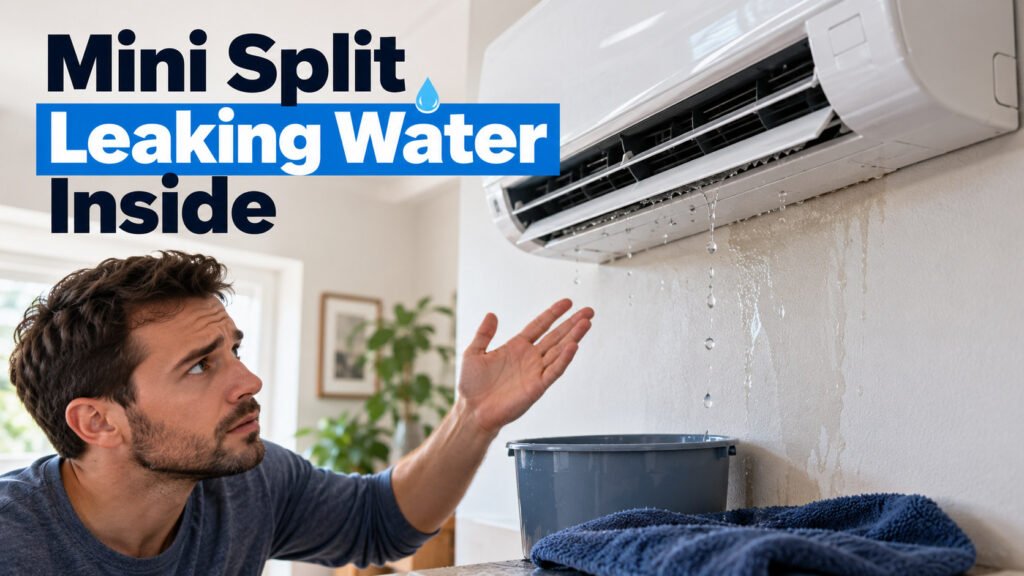
Water dripping from the indoor unit of a mini split (also called a ductless or split AC) usually means the water it pulls out of the air isn’t draining away. The most common causes are ones you can check yourself: dirty filters, ice on the coil, or a drain hose that’s blocked, kinked or sitting in water. This guide works through seven checks from easiest to hardest, so you can stop as soon as the dripping does. Most need no tools.
The checks follow the manufacturers’ own advice and apply to wall-mounted indoor units from any brand. Anything involving refrigerant, wiring or taking the unit off the wall is a job for a technician, and the guide says when you’ve reached that point. For other problems, see all our mini split fixes.
Before you start: Turn the unit off with the remote, then switch it off at the circuit breaker before you open the front panel or touch anything inside. Water near electrics is a hazard, and Bryant advises turning a mini split off while it’s actively leaking (Bryant). Put a towel or tray under the unit, and move anything water could damage, especially electronics and anything plugged in below it.
The 7 checks at a glance
- Make sure it’s a leak, and find where it comes from
- Look for ice on the coil
- Clean the air filters
- Follow the drain hose outside
- Clear the drain with a wet/dry vacuum
- Check the condensate pump (if you have one)
- Check how it was installed
After each check, switch the power back on and run the unit on cooling for an hour or so. If no more water appears, you’re done. If it drips again, switch off at the breaker and move on to the next check.
Check 1: Make sure it’s a leak, and find where it comes from
Some moisture is normal. On a humid day, or when the room is much warmer than the air coming out, dew can form around the air outlet and white mist may blow out with the cold air (LG). Wipe it dry and watch. A real leak keeps dripping or leaves a growing puddle.
Where the water appears is a clue:
- Dripping from the bottom or front while it’s cooling: most likely a drain or airflow problem. Carry on with Checks 2 to 6.
- Water appearing after the unit is switched off: water that didn’t drain while it was running can leak out afterwards (LG), and ice on the coil melts once the unit stops. Start with Check 2.
- Running down the wall around the pipe hole, or only when it rains: often an installation problem. Go to Check 7.
Check 2: Look for ice on the coil
With the power off, lift the front panel and look at the metal fins behind the filters. That’s the evaporator coil. LG notes that frost can build up on it when the air filter is clogged, and the water leaks out as it melts (LG). Melting ice can produce more water than the drain can handle.
- If you see frost or ice, leave the unit off until it has melted completely. Keep towels in place: a lot of water can come out at once.
- Clean the filters (Check 3) while you wait.
- Run the unit again, then check the coil after an hour or two.
Bryant treats a frozen coil as a symptom rather than the cause: it points to an airflow problem or a refrigerant leak (Bryant). If ice comes back with clean filters, stop using the unit and call a technician to check the refrigerant.
Check 3: Clean the air filters
Dirty filters are one of the most common causes of a leak, and the easiest to fix. They choke the airflow over the coil, which can make it ice up.
- With the power off at the breaker, lift the front panel.
- Slide or unclip the filters out. Your manual shows how for your model.
- Vacuum off the dust, then rinse washable filters in lukewarm water, not hot.
- Let them dry completely in the shade before you put them back.
Bryant recommends cleaning mini split filters every two to four weeks, and more often in dusty homes or during heavy use (Bryant). Your manual may give a different interval for your model.
Check 4: Follow the drain hose outside
Water from the coil collects in a drain pan inside the unit, then runs out through a drain hose. The hose usually passes through the wall with the refrigerant pipes and ends outside, on the wall or near the outdoor unit. Find where yours comes out. While the unit is cooling, water dripping from the end is normal: it means the drain is working.
- Kinked or crushed: straighten it, and make sure nothing is standing on it.
- End sitting in water: if it’s in a puddle, a bucket or a drain that has filled up, water can flow back towards the unit. LG says to keep the end of the hose out of the water (LG).
- Pulled off or torn: LG lists a disconnected or torn drain hose as a cause of indoor leaks. If the hose has come off inside the unit, that’s a job for the installer.
- Blocked at the end: clear any mud, leaves, insect nests or slime you can see at the outlet.
Check 5: Clear the drain with a wet/dry vacuum
Bryant names a clogged drain line as a common cause of mini split leaks (Bryant). Dust, mould, algae and debris build up inside the line over time, and the water backs up into the unit. If the end of the hose is dry while the indoor unit drips, this is the likely cause.
The safest way to clear it is from the outside end, with a wet/dry vacuum (also called a shop vac):
- Keep the unit switched off.
- Hold the vacuum nozzle tightly over the end of the drain hose. Wrap a cloth around the joint to get a good seal.
- Run the vacuum for a minute or so, then check what came out.
- Switch the unit back on and run it on cooling. After a while, water should start dripping from the end of the hose again.
If the vacuum doesn’t clear it, Bryant’s advice is to call a professional. Don’t push wire or rods up the hose: you can puncture it, or the drain pan inside the unit.
Check 6: Check the condensate pump (if you have one)
If the water can’t flow downhill to the outside, for example because the indoor unit is on an inside wall, the installer may have fitted a small condensate pump to push it out. It’s usually a small box near the indoor unit or inside the plastic channel that covers the pipes. If you have one:
- Check it has power. LG points out that the pump needs its own power supply, separate from the air conditioner (LG), so make sure it’s plugged in and its switch or breaker is on.
- Check the drain from the indoor unit is still connected to the pump.
- Listen near it while the unit is cooling. If it never runs, or the unit leaks while the pump is running, the pump may be blocked or failed.
Opening or replacing the pump means working on wiring and pipework, so leave that to a technician or your installer.
Check 7: Check how it was installed
If the unit is new, or it leaks even with clean filters and a clear drain, the way it was fitted may be the problem.
- Level and slope: if the indoor unit isn’t level, water pools instead of draining. The drain line also has to run downhill all the way: Bryant’s installation guidance calls for a drop of at least about 1/8 inch per foot (Bryant). A spirit level on top of the unit shows whether it’s tilted, and a hose that rises anywhere along its run will trap water.
- Leaks only when it rains: rainwater can run along the pipes and into the room through the wall hole. LG says this happens when the pipes have no dip (a U-trap) outside to let the rain drip off, and that the installer should fix it (LG).
- Water around the pipe hole: Bryant notes that refrigerant pipes without enough insulation can sweat and drip inside.
Don’t try to remount the indoor unit or re-route the pipes yourself: they carry refrigerant. If the unit was installed recently, contact the installer first.
When to call a technician
Stop and call a technician if: ice keeps forming on the coil with clean filters; the cooling has become weak; the drain is still blocked after you’ve vacuumed it; the unit leaks from inside even though the drain runs freely, which can mean a cracked drain pan; water is reaching the electrics or the unit trips the breaker; or the fix means taking the unit off the wall. Refrigerant needs a qualified technician to find and repair the leak: Bryant warns homeowners not to add refrigerant themselves (Bryant).
When you book, have the brand and model number from the label on the indoor unit, any error code or flashing light, and a list of the checks you’ve already done. It saves time on the visit.
Common questions
Why is my mini split leaking water inside?
Usually because of a blocked drain line, dirty filters or ice on the coil melting. Less often, the cause is a damaged drain pan, a failed condensate pump or a fitting problem. LG lists a clogged drain line, a damaged or rusted drain pan, a dirty air filter and low refrigerant as the main causes (LG). Work through Checks 2 to 7.
Is water dripping outside normal?
Yes. When it cools, a mini split removes moisture from the air and drains it outside through the hose. Water dripping from the end of the hose means the drain is doing its job.
How often should I clean mini split filters?
Bryant recommends every two to four weeks. Your manual may give a different interval, and dusty rooms or heavy use need more frequent cleaning.
Can I keep using my mini split while it’s leaking?
It’s best not to. Turn it off until you’ve found the cause, because water near the electrics is a safety hazard and the leak can damage your walls and floor.
Stuck on a step?
Ask below with your appliance's brand and model number, and we'll help if it's safe to fix at home.