
Washer Not Filling With Water? Check the Hose and Filter
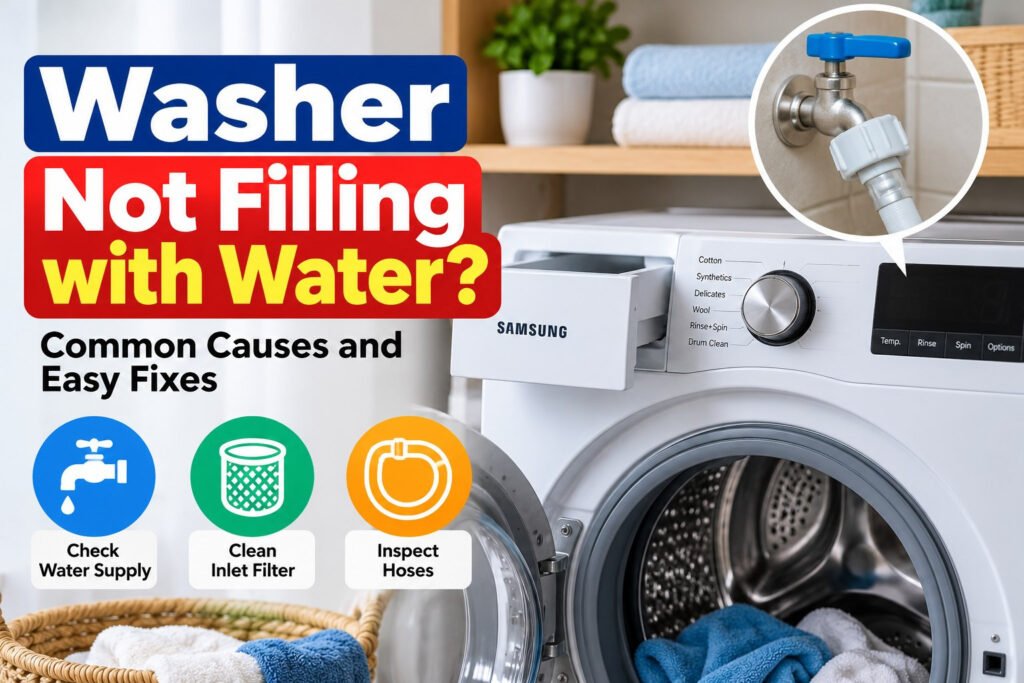
You’ve started a wash, but the drum stays dry or water only trickles in. When a washer is not filling with water, the cause is usually outside the machine: a closed tap, a squashed hose or a blocked filter screen. Work through these seven checks in order and stop when water flows. Most need no tools.
Each check says where front-loaders and top-loaders differ. For other problems, see all our washing machine fixes.
Before you start: Unplug the washer from the wall socket (outlet) and turn off the water tap (faucet) behind it before you touch any hose. The hot hose can hold hot water, so undo it with care. Keep a bowl and a towel ready: water runs out when a hose comes off. If your hose has a plastic box near the tap, such as a Bosch AquaStop, never put it in water. It contains an electric valve.
The 7 checks at a glance
- Is water reaching the washer?
- Has the cycle really started?
- Look for a kinked or squashed hose
- Clean the inlet filter screens
- Test the water pressure
- Read the error code
- Inlet valve or pressure faults
After each check, turn the taps on, plug in and start a short cycle. If water flows in, you’re done. If not, unplug again and move on.
Check 1: Is water reaching the washer?
Turn on the kitchen tap first. If other taps are dry or weak too, the problem is the house supply, not the washer (Whirlpool).
- The washer’s taps: Follow the hose to the wall. LG says to turn a closed valve anticlockwise (counterclockwise) until it’s fully open (LG). Samsung says to leave the valves fully open while the washer runs (Samsung).
- Hot and cold: If your washer has two hoses, Whirlpool says both must be connected and turned on (Whirlpool). Many machines fill from cold only: Samsung says all but one model in its UK range has a cold connection only (Samsung).
- Lever taps: Whitegoods Help, a UK repair site, warns that the plastic lever on blue and red washer taps can crack while the valve stays shut (Whitegoods Help). The bucket test in Check 5 shows whether water comes out.
- Frozen pipes: In an unheated garage or utility room, cold weather can slow or stop the flow (Whirlpool). LG suggests thawing a frozen valve or hose with a warm towel at 50 to 60°C (122 to 140°F) (LG).
Check 2: Has the cycle really started?
Whirlpool says most top-loaders and front-loaders won’t start filling unless the lid or door is fully latched (Whirlpool). Beko says the same (Beko).
- Door or lid: Free any clothing caught in the seal, then shut the door until you hear it lock.
- Delay start: Whirlpool calls an accidental delay start easy to overlook (Whirlpool). Cancel it to wash now.
- Child lock: Electrolux says to turn child lock off, press Start, then turn it back on (Electrolux).
- Paused cycle: Electrolux lists an unpressed Start/Pause button as a reason a washer doesn’t start. Press it once.
Some washers move the drum briefly before filling to sense the load, which Whirlpool says can be normal.
Check 3: Look for a kinked or squashed hose
Pull the washer forward and follow the inlet hose from the back to the tap. It’s the narrower hose, not the ribbed drain hose. A washer pushed tight against the wall often crushes it. Whitegoods Help calls a kinked hose “one of the most common and easily overlooked causes” (Whitegoods Help).
- Straighten bends and loops, and leave a gap behind the machine. Miele warns the plastic may weaken and tear where it kinked, so watch that spot (Miele).
- Check both ends are screwed on firmly: Whirlpool says a loose joint lets air in and lowers the pressure.
- Samsung says not to use Flood Safe hoses (Samsung). LG says they can cause an IE error (LG).
- If the hose is split, cracked, bulging or leaking, replace it before using the washer (Beko). Whirlpool says fill hoses should be replaced every five years (Whirlpool).
Look at the drain hose too
LG says that on a front-loader, a drain hose placed too low, or with its end under water, can drain water out as the washer fills (LG). Samsung says it shouldn’t go more than 6 inches (15 cm) into the drain pipe. Our drain guide covers where the hose should sit.
Check 4: Clean the inlet filter screens
Each inlet has a small mesh screen that stops grit reaching the water valve. LG says it “collects lime or any sediment that may be in water” (LG). Over time it clogs with mineral deposits and debris (Whirlpool), and the water slows or stops.
Where to look: On most washers the screen sits where the hose meets the back of the machine. Bosch AquaStop hoses (Bosch) and Miele hoses (Miele) have a filter at the tap end. Your manual shows where yours are.
- Unplug the washer and turn off both taps, or the one tap on a cold-only machine.
- Put the towel down, hold the bowl under the joint and unscrew the hose from the machine by hand. If the screen is at the tap end, unscrew that end too.
- Check the rubber washer is still inside each hose nut. Samsung notes a missing washer may cause a leak (Samsung).
- Scrub the mesh with an old toothbrush under running water. Whirlpool suggests mild soap and water (Whirlpool). Rinse the connector threads too.
- Follow your manufacturer on removing the screen. Whirlpool says to clean its screens in place. Samsung (Samsung), LG and Bosch say to pull the filter out with pliers. Miele says it must go back in after cleaning. Never run the washer without it.
- If the mesh is torn, don’t refit it. Whitegoods Help says even a small hole lets grit and debris into the valve. Get a replacement for your model.
- Screw the hose back on hand-tight, as Beko advises (Beko), plus anything extra your manual says.
- Turn the taps on slowly and check for drips. Miele says to tighten the joint if it drips.
AquaStop hoses: Never put the box in water (Bosch). Clean the tap-end filter with a small brush.
Cleaning products: Water and mild soap are enough. Never mix bleach with vinegar or other cleaners: it releases toxic gas.
How often: Samsung recommends cleaning the mesh filter at least twice a year. For every other part, see how often to clean your washing machine. LG says every six months or so, or more often if the water is very hard or contains traces of limescale. After plumbing work or in a newly plumbed home, check the screens early, since they catch sediment from the supply.
Check 5: Test the water pressure
If water comes in slowly, the pressure may be too low. If the drum can’t fill in the time the machine allows, it stops and shows an error code (Whitegoods Help). Bosch’s bucket test checks the flow:
- Turn the tap off and unscrew the inlet hose from it.
- Put a bucket under the tap and open it fully.
- Bosch says about 10 litres (2.5 US gallons) should come out per minute (Bosch). Miele’s test is stricter: at least 5 litres within 15 seconds (Miele).
Published ranges vary by brand. LG says supply pressure must be between 14.5 and 116 psi (1 to 8 bar) (LG). Samsung gives 20 to 116 psi (about 1.4 to 8 bar). Below 20 psi, it warns, the water valve can fail or not shut off completely (Samsung). UK water companies must supply at least 1 bar, which should suit most machines (Whitegoods Help).
If the flow is too low, or almost nothing comes out, Bosch and Miele both say to contact a plumber.
Check 6: Read the error code
Many washers show a code when water doesn’t come in. These are the manufacturers’ own meanings:
| Brand | Code | What it means |
|---|---|---|
| Samsung | nF, 4C, 4E, 1 4C | Water is not entering the washer correctly (Samsung) |
| Samsung | nF1, 4C2, 4E2 | Hot and cold hoses swapped: the cold supply is extremely hot |
| LG | IE | Water is not flowing into the washer properly (LG) |
| Bosch | Tap symbol | A problem with the water inlet (Bosch) |
| Miele | F10 | The water inlet is blocked or restricted (Miele) |
The fixes are the checks above. Samsung also suggests cutting power at the plug or circuit breaker for 1 minute, then trying again. Its swapped-hose code needs no service: reconnect the hoses correctly. For other brands, check your manual.
Check 7: Inlet valve or pressure faults
If the tap, hose, screens and pressure are all fine, the fault is probably inside the machine:
- Inlet valve: Whitegoods Help explains that if the valve’s coil fails, it won’t open whatever the control board says (Whitegoods Help). Filling on some cycles but not others can mean one failed valve.
- Pressure system: If it wrongly detects water already in the drum, the washer may not fill. If the drum turns with no water in it, switch off straight away: Whitegoods Help warns a heater running dry is a fire risk.
Inlet valves carry a live supply even when idle (Whitegoods Help). Don’t open the machine: Whirlpool says internal components should be handled by a qualified technician (Whirlpool).
When to call a technician
Stop and call a technician if: water still won’t come in with the taps fully open and the screens clean; the washer keeps filling and won’t stop (turn off the taps and unplug it first); it hums or the drum turns with no water coming in; you smell burning or anything electrical; or the fix means taking off the back or top panel. If an inlet hose is bulging or cracked, don’t use the washer until the hose is replaced.
When you book, have the brand, model number and any error code ready. Say which checks you’ve done.
Common questions
Why is my washer not filling with water but the power is on?
Usually the cycle hasn’t really started or water can’t get in. Check the door is latched and that delay start, child lock or pause isn’t set. Then check the taps, hose and screens.
Where is the inlet filter on a washing machine?
Usually where the inlet hose screws onto the back of the machine. Bosch and Miele also put one in the tap end of the hose. Check your manual.
Can low water pressure stop a washer filling?
Yes. If the drum doesn’t fill in the time the machine allows, it can stop and show an error code. Bosch says a fully open tap should give about 10 litres (2.5 US gallons) a minute.
Sources
- Washing machine won’t fill with water (Whirlpool)
- Checking the fill hoses if the washer is not filling (Whirlpool)
- Washing machine does not fill up or drain (Samsung UK)
- Not enough water entering the washing machine (Samsung NZ)
- Samsung washing machine information and error codes (Samsung)
- Water pressure range for Samsung washing machines (Samsung)
- Front load washer not filling, IE error code (LG)
- Inlet hose installation: washing machine (LG)
- Cleaning the water inlet filter (LG)
- Washing machine not filling up with water (Bosch)
- Water tap symbol in the display (Bosch)
- How to fix a washing machine that won’t fill with water (Beko)
- Fault F10 (Miele)
- Washing machine does not start (Electrolux)
- Washing machine won’t fill with water (Whitegoods Help)
- Low water pressure and washing machines (Whitegoods Help)
Stuck on a step?
Ask below with your appliance's brand and model number, and we'll help if it's safe to fix at home.