
Front Load Washer Smell? 6 Fixes, From Seal to Drain
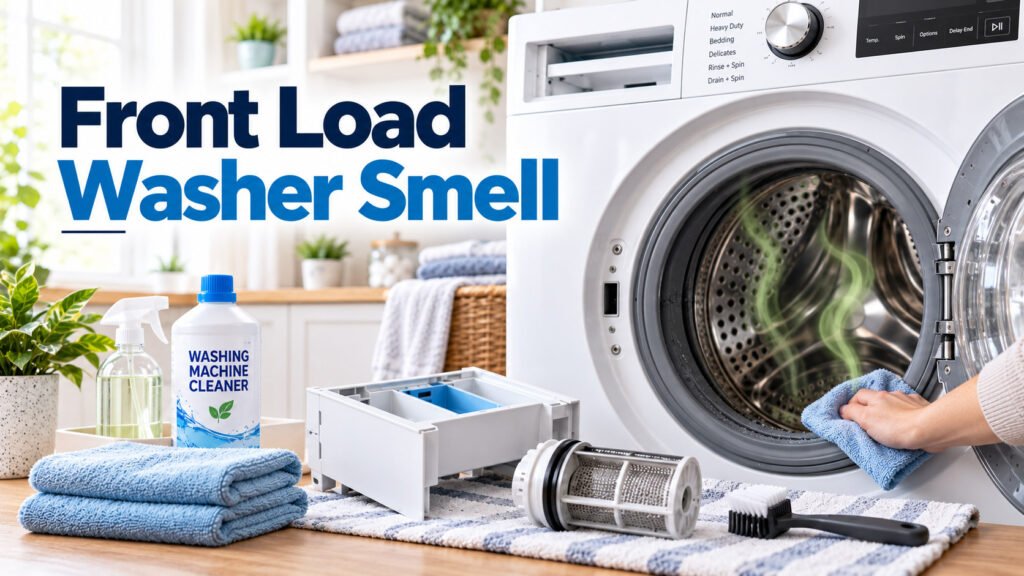
A musty, damp smell from a front-loader usually comes from inside the machine: residue, lint and mould in the door seal, detergent drawer and pump filter. A sewage or rotten-egg smell often comes from the drain instead. The six fixes below follow the manufacturers’ own advice. Most need no tools, just a cloth, a soft brush and warm water.
Brands disagree on bleach and vinegar, so each step says whose advice it is. For other problems, see all our washing machine fixes.
Before you start: Unplug the washer before you clean inside the door seal or open the pump filter. Wear rubber gloves, and open a window if you use bleach. Never mix bleach with vinegar or ammonia-based cleaners: together they release toxic gas (Health Canada). Follow your brand’s guidance on bleach, and check the manual before using vinegar. Water behind the pump filter can be hot after a warm wash, so let it cool first.
The 6 fixes at a glance
- Clean the door seal folds
- Clean the detergent drawer and its housing
- Clean the pump filter
- Run the drum clean cycle
- Fix the habits that cause the smell
- Sewage or rotten eggs? Check the drain
What kind of smell is it?
- Musty, mouldy or damp: this comes from inside the machine, where moisture and residue let mould grow (Whirlpool). It may be worse right after a wash (Whitegoods Help). Start with Fix 1.
- Sewage, drain or rotten eggs: often the drain, not the washer (Fix 6). Samsung says a sulphur or sewage smell means the drain hose is in too deep and dirty water is siphoning back (Samsung). Bosch also links rotten-egg smells to cool washes and small detergent doses (Bosch), so do Fixes 1 to 4 as well.
- Burning: Samsung says a new washer can smell on its first couple of cycles. If it carries on, get it checked.
Fix 1: Clean the door seal folds
The rubber seal (gasket) around the door traps water, lint and detergent. LG says lint and hair caught in it can hold water and let mould form (LG).
- Unplug the machine and open the door. Remove anything caught in the seal, checking the groove at the six o’clock position (LG).
- Gently fold back the inner lip to see into the folds, as Samsung and LG describe. Don’t force it: Beko says not to lift the seal away from the metal (Beko).
- Wipe inside the folds with a soft cloth. For buildup, Samsung suggests warm water with mild soap (Samsung Canada).
- Rinse with a damp cloth, then dry the seal completely, including the bottom fold. Leave the door open to air-dry.
Black mould spots? LG and Whirlpool give the same mix: 177 ml (¾ cup) of liquid chlorine bleach in 3.8 litres (1 gallon) of warm water. Whirlpool says to leave it about 5 minutes, then rinse (Whirlpool). LG warns never to use undiluted bleach, which can make the seal deteriorate. Its odour page suggests oxygen-based bleach instead. Some front-loaders can’t take bleach (Whirlpool), so check your manual.
Vinegar and other cleaners: LG allows vinegar in place of bleach, and Beko suggests vinegar with baking soda. Bosch says not to use vinegar, as it can attack rubber parts (Bosch). Electrolux suggests an ammonia-based cream cleanser every two months (Electrolux), which must never meet bleach. Use one product your manual allows.
Fix 2: Clean the detergent drawer and its housing
Old detergent and softener collect in the drawer and the recess behind it. LG says detergent may not fully dissolve in cold washes, leaving buildup and odour.
- Pull the drawer out until it stops, then release it. LG drawers have a tab between the bleach and softener sections. Many Samsung drawers have a lever inside. Your manual shows how.
- Remove the inserts and wash every part in warm water with a soft brush, including the underside (LG).
- Shine a torch (flashlight) into the empty recess and scrub it with the brush.
- Refit the drawer. Samsung suggests an empty Rinse+Spin to clear loosened detergent (Samsung UK).
How often: Samsung Canada says about once a month, Whirlpool every 30 cycles, and Beko every four to five washes. Full brand-by-brand schedule: how often to clean your washing machine.
Fix 3: Clean the pump filter
A clogged pump filter leaves water standing in the machine. LG and Samsung both say this causes odour.
The filter sits behind a small cover at the bottom front, with water behind it. Drain that first: our guide to a washer that won’t drain shows how. Then:
- Unscrew the filter anticlockwise (counterclockwise) and pull it out.
- Clean off lint and hair with a soft brush and warm water. LG says not to put it in the dishwasher.
- Brush out the opening, screw the filter back until it stops turning, and refit the cap on any small drain hose.
How often: LG says monthly, with the tub clean. Samsung Canada says at least monthly or about every 40 washes, and Beko every three months.
Fix 4: Run the drum clean cycle
Most front-loaders have a cleaning cycle that runs hot with the drum empty. What you add depends on the brand, and the wrong product can harm the machine.
| Brand | Cycle | What to add | How often |
|---|---|---|---|
| Samsung (US, Canada) | Self Clean, Self Clean+ or Pure Cycle | Usually nothing. For mildew or visible mould: liquid chlorine bleach in the detergent compartment, up to MAX | Monthly, or every 30 to 40 loads |
| Samsung (UK) | Eco Drum Clean (60 to 70°C) or Eco Drum Clean+ | No cleaning agent or detergent | Reminder every 40 washes |
| LG | Tub Clean | Tub cleaner, as the pack directs | Monthly |
| Whirlpool | Clean Washer | Washer cleaner such as affresh | Monthly, or every 30 cycles |
| Beko | DrumClean+ (70°C) | Ideally a cleaning agent | Every 1 to 3 months |
| Electrolux | Empty Cotton 90°C (95°C on some) | A little detergent | “CLE” reminder, every 60 washes |
| Bosch | Regular washes at 60°C or more | Bosch’s own machine cleaner | Regularly |
From Samsung US, Samsung Canada, Samsung UK, LG, Whirlpool, Beko, Electrolux and Bosch. 60°C is 140°F, 70°C is 158°F and 90°C is 194°F.
Always run it empty: Samsung warns that laundry in Self Clean can damage the washer and the clothes. Don’t pour bleach straight into the drum (Samsung Canada), and never add bleach after vinegar or another cleaner in the same clean.
Afterwards, wipe out residue with kitchen roll (paper towels), run a Rinse+Spin and leave the door and drawer open (Samsung). No cleaning cycle? Beko suggests an empty wash at the hottest temperature, without detergent. Already smelly? LG says to run Tub Clean once a week for 3 weeks.
Fix 5: Fix the habits that cause the smell
These habits stop the smell coming back.
- Take laundry out promptly: Samsung calls wet clothes left in the drum one of the most common sources of odours.
- Use the right detergent: Samsung and Whirlpool say to use HE (high-efficiency) detergent. Samsung prefers powder, as it leaves less buildup.
- Get the dose right: too much leaves smelly soap scum, Samsung says, so never fill past MAX. Too little causes problems too (Bosch). Follow the pack for your load and water hardness (Whitegoods Help).
- Go easy on fabric softener: Samsung, Whirlpool and Beko all say its residue builds up. Samsung suggests dryer sheets instead.
- Run a hot wash now and then: Bosch says to wash regularly at 60°C (140°F) or higher. Whirlpool suggests an occasional hot cycle if you mostly wash cold. Check care labels first.
- Leave the door and drawer ajar: Whirlpool, Samsung and Beko all say to leave the door open, and Samsung adds the drawer. Wipe the seal dry after each wash too (Samsung, Electrolux). With small children or pets, check the drum before every wash.
Fix 6: Sewage or rotten eggs? Check the drain
If it smells like a drain and is worse in the morning or after a few days unused, look behind the machine first (Whitegoods Help).
- Hose in too deep: Samsung says this lets dirty water siphon back. Pull the hose out, clean the end, and refit it no more than about 15 cm (6 in) into the standpipe. That’s the stricter of two limits Samsung gives. Secure it so it can’t slip. Don’t remove the screw holding the hose to the back of the washer.
- Dry trap: the U-bend (P-trap) under a standpipe holds water that blocks sewer gas, and it can dry out if the washer sits unused. Sears Home Services says to pour a bucket of water down the standpipe to restore it (Sears).
- No trap at all: Whitegoods Help says a waste pipe without a U-bend is the most likely cause of an outside-drain smell. A hose into a floor drain or gully (common in India) needs a water seal too.
- Sink connection (common in the UK): if the hose joins the sink’s U-bend, it must loop up at least 8 to 10 cm (3 to 4 in) before dropping to the machine (Whitegoods Help). Without the loop, sink water can siphon in.
- Blocked hose or drain: lint and soap scum in the hose or standpipe can smell too (Sears). Check the hose for kinks and clogs (Whirlpool), and clean the pump filter.
When it’s a plumber’s job: if a trap needs fitting, the drain stays blocked, or the smell comes from the walls around a vent pipe. Sears says that can mean a blocked vent. Whirlpool also advises a professional for a clogged P-trap.
When to call a technician
Stop and call a technician if: mould in the seal or drum keeps coming back after cleaning; the seal is torn or split; water leaks from the seal or from under the machine; you smell burning after the first couple of cycles; or the smell survives several cleaning cycles. Electrolux says a seal that stays mouldy must be replaced by a professional. LG and Samsung advise service if odour persists after repeated cleans.
When you book, have the brand, model number and any error code ready, and say which fixes you’ve already tried.
Common questions
Why does my front loader smell like rotten eggs?
Usually the drain. Samsung says the hose is in too deep and dirty water is siphoning back. A dry or missing trap can also let drain smells in. Start with Fix 6.
Can I use vinegar to clean the gasket?
LG and Beko allow it. Bosch says not to, as it can damage rubber, and Whitegoods Help warns that regular use can degrade seals. Never use it with bleach.
How often should I clean the door seal?
Wipe it dry after every wash (Samsung, Whirlpool, Electrolux). For a deeper clean, Beko says monthly, Whirlpool about once a month or every 30 cycles, and Electrolux every two months.
Sources
- Samsung washing machine or laundry smells bad (Samsung US)
- How to clean your Samsung washer (Samsung Canada)
- How to clean washing machine drum & what are the cleaning functions (Samsung UK)
- How to Clean the Tub of Your LG Washing Machine (LG US)
- LG Washer: Troubleshooting Odor / Buildup (LG US)
- How to remove odors and smells in a front load washer (Whirlpool)
- How to clean the gasket on a front load washer (Whirlpool Canada)
- What should I do when my washing machine smells of rotten eggs? (Bosch)
- Does vinegar help when my washing machine smells? (Bosch)
- How to clean your washing machine’s door seals (Beko UK)
- How to clean a washing machine (Beko UK)
- Cleaning the washing machine’s rubber seal if it’s dirty (Electrolux UK)
- Washing machine displays “CLE”: drum cleaning reminder (Electrolux UK)
- Get rid of washing machine smells (Whitegoods Help)
- Smells caused by plumbing faults (Whitegoods Help)
- Why does my washer smell like sewage? (Sears Home Services)
- Never mix bleach with other cleaning products (Health Canada)
Stuck on a step?
Ask below with your appliance's brand and model number, and we'll help if it's safe to fix at home.