
Washing Machine Maintenance: The Complete Schedule
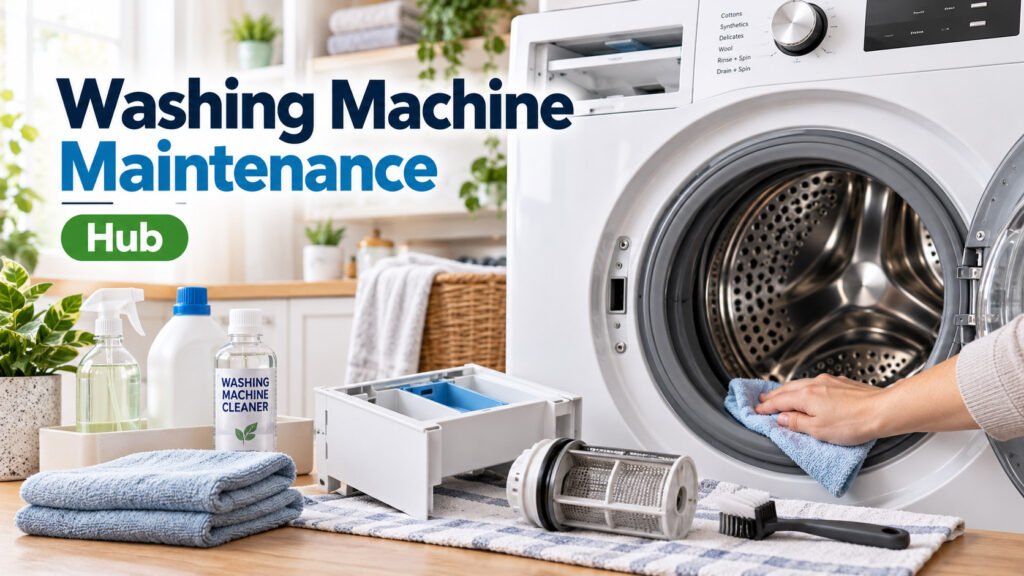
A washing machine needs little care, but it does need some. Skip it and you get a musty smell, a blocked filter, a slow fill or a leaking hose. This guide gives you one schedule for front-loaders and top-loaders, built from the manufacturers’ own advice.
Brands don’t always agree, so the guide says whose advice is whose. Your manual has the final word for your model. Each section links to a detailed guide, and all our washing machine fixes are in one place.
Before you start: Unplug the washer at the mains (outlet) before cleaning any filter, seal or drawer. Turn off the water taps (faucets) before you touch the hoses or filters. Water in the drain filter can be hot after a warm wash, so let it cool. Never mix bleach with vinegar or other cleaners: bleach and acids release chlorine gas (NJ Department of Health). Wear rubber gloves when using bleach.
What you need
- Cloths, old towels, a soft brush and a shallow tray
- Needle-nose pliers, a spirit level and a spanner (wrench)
- The washer cleaner your manual recommends
Your washing machine maintenance schedule
Tap a task to jump to the how-to. Where your manual differs, follow your manual.
| When | Task | Front-loader | Top-loader |
|---|---|---|---|
| After every wash | Let it dry out | Leave the door and drawer open. Wipe the seal dry. | Leave the lid open. |
| Every wash | Right detergent and dose; don’t overload | HE detergent if your manual asks for it. Leave a hand’s width at the top (Bosch). | HE detergent if your manual asks for it. Keep to the maximum load. |
| Every month | Clean the drawer and seal; drum clean; check level | Drum clean: LG, Whirlpool and Beko monthly. Samsung every 40 washes. Bosch every 3 months. | Clean the dispenser and run the clean cycle (Whirlpool: every 30 days). |
| Every 3 months | Drain pump filter or lint filter | Beko: every 3 months. Samsung: 5 or 6 times a year. LG: with the monthly tub clean. | Lint filter, if your model has one. |
| Every year | Inlet filter screens; check hoses | Samsung: inlet filters once or twice a year. | Same as front-loaders. |
| Every 5 years | Replace inlet hoses | Whirlpool: after 5 years of use. | Same as front-loaders. |
Take clothes out and leave the door open
Damp trapped in a closed machine lets mould and smells build up in the seal and drawer.
- Take the washing out as soon as the cycle ends (Samsung).
- Beko suggests leaving the door and drawer open for about 30 minutes after each wash (Beko). Whirlpool says to leave the door or lid open between washes (Whirlpool).
- On a front-loader, wipe the seal and glass dry at the end of each wash day, as LG advises (LG).
With small children or pets around, leave the door just ajar and keep the room closed. Smell already? See front-load washer smells: gasket and drawer.
Use the right detergent and dose
Samsung says too much detergent “will create buildup inside the washer” (Samsung). Whirlpool says excess suds can mean “very wet loads or error codes” (Whirlpool).
- HE: if your manual says HE (high-efficiency), use only HE detergent. Otherwise, use one made for your machine type.
- Dose: follow the pack for your load size and soil level. Whirlpool says very soft water may need less. In hard-water areas, packs often say to use more (Which?).
- Pods: Samsung says to put them in the drum before the clothes, not in the drawer.
Stopped mid-wash with a code? See washer won’t finish the cycle, Samsung washer error codes or LG washer error codes.
Don’t overload the drum
Bosch recommends leaving “a hands width gap at the top of the washing machine drum”, roughly three-quarters full. It says overloading moves laundry “in one large mass” and can damage the drum bearings on fast spins. Underloading can cause banging from an unbalanced load (Bosch). If in doubt, Which? suggests two-thirds full.
Check your manual for the maximum load. Clothes still soaking wet at the end? See washer won’t spin but drains. Shaking anyway? See washer shaking hard on spin: level and balance.
Clean the detergent drawer
Residue builds up in the drawer and can go mouldy. LG says debris can also make the dispenser overfill and leak (LG).
- Pull the drawer out, press the release lever or tab, and lift it out.
- Scrub every part under running water with a soft brush (Samsung). LG says not to use a dishwasher.
- Brush out the empty recess, refit the parts and slide the drawer back.
How often: Beko UK says every four to five washes (Beko UK). LG, Whirlpool and Beko Australia say monthly.
Wipe the door seal (front-loaders)
Mould can form in the rubber seal where water collects (Samsung). Hair and coins gather in the fold at the bottom.
- Pull back the fold and clear the groove at the bottom (LG).
- Wipe all round, and under the lip, with a damp cloth.
- For mould, LG suggests 177 ml (¾ cup) of chlorine bleach in 3.8 litres (1 US gallon) of warm water, or vinegar instead. Never use both, and never use neat bleach. Samsung warns bleach may damage the seal, so check your manual.
- Dry the seal and leave the door open.
How often: monthly, say LG (LG), Beko UK and Which?.
Run a drum clean or tub clean cycle
A drum clean is an empty, hot cycle that removes detergent and softener residue and helps prevent smells (Bosch).
- Empty the drum. Samsung says never to run its drum clean with laundry inside (Samsung).
- Add only the cleaner your manual names, or nothing. Samsung says not to use ordinary laundry detergent.
- Start Drum Clean, Tub Clean or Clean Washer. No such programme? Beko suggests an empty cycle at the hottest temperature, without detergent (Beko UK).
- Afterwards, leave the door and drawer open to dry (LG).
How often: LG (LG), Whirlpool and Beko Australia say monthly. Samsung models with ECO DRUM CLEAN+ remind you every 40 washes. Bosch recommends its washer cleaner every three months. See how often to run a drum clean.
Check the machine is level
Samsung says “excessive noise and vibrations may occur” if a washer isn’t levelled properly (Samsung).
- Empty the drum and check the machine isn’t touching anything. New front-loader? Check the transit (shipping) bolts are out.
- Press down on opposite corners. If it rocks, a foot is off the floor.
- Check side to side and front to back with a spirit level.
- Loosen the lock nut, screw the foot in or out, then retighten the nut. Directions vary by model, and Samsung warns that force can damage the feet.
- Top-loader? Samsung’s test: fill with water to just below the pulsator. If it’s level, the pulsator sits in the centre of the water.
How often: Beko puts a level check in its monthly checklist (Beko). Check again after any move.
Clean the drain pump filter (front-loaders) or lint filter
On most front-loaders, this filter sits behind a small cover at the bottom front. It catches fluff, coins and buttons. LG says cleaning it is “very important to keep your unit from leaking” (LG).
- Unplug the machine. Put towels and a shallow tray under the cover.
- Drain the water through the small hose, if there is one.
- Turn the filter anticlockwise, pull it out and brush it clean under warm water.
- Screw it back in. LG says it must be “threaded correctly and tightened all the way”.
How often: LG says to clean it with the monthly tub clean, Samsung five or six times a year (Samsung), and Beko every three months (Beko UK). Full steps: how to clean a washer drain pump filter. Water stuck in the drum? See washing machine not draining.
Top-loaders: most have no drain filter you can open. Some have a lint filter in the drum. Press down the top of the case to remove it, rinse it with a brush, and let it dry before refitting (Samsung). Never tip a top-loader to reach its pump.
Clean the inlet hose filter screens
Small mesh filters where the hoses meet the machine catch grit and limescale. Clogged, they slow the fill, and Samsung washers may show code 4C (Samsung).
- Unplug the washer and turn the taps off fully.
- With a bucket ready, unscrew the hoses from the machine.
- If your manual says to, pull each filter out gently with needle-nose pliers (Whirlpool cleans its screens in place). Rinse it, or soak off limescale in white vinegar or limescale remover (LG).
- Refit the filters and hoses, turn the taps on and check for drips.
How often: Samsung says once or twice a year (Samsung). LG says they clog faster in hard water. Slow fill? See washer not filling with water.
Check the hoses, and replace them in time
Inlet hoses are under pressure whenever the taps are on, so a split one can flood a room.
- With the taps off, ease the machine forward without stretching the hoses.
- Whirlpool says to replace inlet hoses “if bulges, kinks, cuts, wear, or leaks are found” (Whirlpool). Check the drain hose for cracks too.
- Look for drips or damp patches at both ends.
- Write the fitting date on the label of new hoses (Whirlpool).
How often: Beko suggests checking hoses seasonally and yearly. Whirlpool says to replace inlet hoses after 5 years of use. A drain hose that connects inside the cabinet is a technician’s job. Water on the floor? See leaking from the bottom.
Washer problems? Start here
Already have a fault? These guides work through the fix, easiest checks first.
- Washing machine not draining
- Front-load washer smells: gasket and drawer
- Washer shaking hard on spin: level and balance
- Washing machine leaking from the bottom
- Washer won’t finish the cycle
- Washer not filling with water
- Samsung washer error codes
- LG washer error codes
When to call a technician
Stop and call a technician if: water leaks from under the machine rather than a hose end; you smell burning or see scorched wiring; the drum grinds or clunks on the spin; the pump hums or stays silent with the filter clear; or the fix means opening the back panel or base, replacing the pump, motor, door lock or inlet valve, or tipping the machine over.
When you book, have the brand, model number and any error code ready, and say what you’ve already checked.
Common questions
How often should a washing machine be serviced?
None of the manufacturer guides cited here sets a professional service interval for home washers. They ask for the routine care above. Call a technician when you see a warning sign.
How long does a washing machine last?
Which? says a washer should ideally “last well beyond seven years without a hitch”. Its research found one in eight develop a fault by seven years old (Which?).
How often should I replace washing machine hoses?
Whirlpool says to replace inlet hoses after 5 years of use, or sooner if you find bulges, kinks, cuts, wear or leaks.
Sources
- Cleaning functions on the washing machine (Samsung UK)
- How to maintain Samsung washing machine after use (Samsung)
- How to use detergent in your Samsung washer (Samsung US)
- How do I level my washing machine? (Samsung Australia)
- Cleaning the top load lint filter (Samsung Australia)
- How to clean the tub of your LG washer (LG US)
- LG front load washer maintenance (LG US)
- How to clean a washing machine (Whirlpool Canada)
- Excessive detergent or suds (Whirlpool)
- Non-usage or vacation care for a washer (Whirlpool)
- Washing machine maintenance checklist (Beko Australia)
- How to clean a washing machine (Beko UK)
- How much should I fill my washing machine? (Bosch UK)
- Cleaning your washing machine (Bosch UK)
- Six ways to make your washing machine last longer (Which?)
- Mixing bleach with other cleaning products (NJ Department of Health)
Stuck on a step?
Ask below with your appliance's brand and model number, and we'll help if it's safe to fix at home.