
Washer Won’t Spin but Drains? 8 Checks, Easiest First

The water has gone, but the drum never spun and your clothes come out soaking wet. When a washer drains but won’t spin, the cause is usually something you can sort out yourself: a low-spin setting, a load that’s off balance, too many suds or a part-blocked filter. Work through these eight checks in order and stop when the drum spins again. Most need no tools.
Each check says where front-loaders and top-loaders differ. If your machine stops completely partway through, see washer stops mid cycle; if it spins but shakes hard, see washer shaking on spin. For other problems, see all our washing machine fixes.
Before you start: Unplug the washer from the wall socket (outlet) before you reach into the drum, open the filter flap or move the machine. Water in the drum or filter can be hot after a warm wash, so let it cool. Never force a locked door or lid open, and never tape down or bypass the lid switch or door lock: they keep the drum from spinning while your hands can reach it.
The 8 checks at a glance
- Is it really not spinning?
- Check the programme and spin speed
- Rebalance the load
- Take some items out
- Cut the suds
- Clear the drain hose and pump filter
- Check the door or lid lock
- Level it, reset it and test the spin
After each check, run a Drain & Spin or Rinse & Spin programme (cycle) with the clothes still inside. If the drum spins up, you’re done. If not, unplug again and move on.
Check 1: Is it really not spinning?
Watch the last few minutes of a cycle before you change anything. A front-loader often turns the drum in short bursts while it tries to balance the load, and Samsung says stopping and starting a few times is normal (Samsung). If the time remaining sticks for a long while, for example on 9 minutes, Samsung says the cause is most likely an unbalanced load, so go to Check 3.
- Top-loaders: Whirlpool says the washer may refill and gently rock the basket to even out an off-balance load before it tries to spin again (Whirlpool).
- After a power cut: if the power went off or a breaker tripped during the spin, Whirlpool says the washer may not reach full spin speed. Run a Drain & Spin programme to finish the job (Whirlpool).
- Damp or dripping? Clothes that are damp after a delicate or wool programme are normal. Clothes that drip when you lift them out mean the spin didn’t happen, or ran very slowly. If they come out of the washer well spun but stay damp in the dryer, the dryer is the problem: see dryer not drying.
Check 2: Check the programme and spin speed
Whirlpool’s first suspect is the setting itself: “Low- or no-spin cycle settings reduce or eliminate spinning” (Whirlpool). It also says cycles with lower spin speeds remove less water than cycles with high spin speeds (Whirlpool).
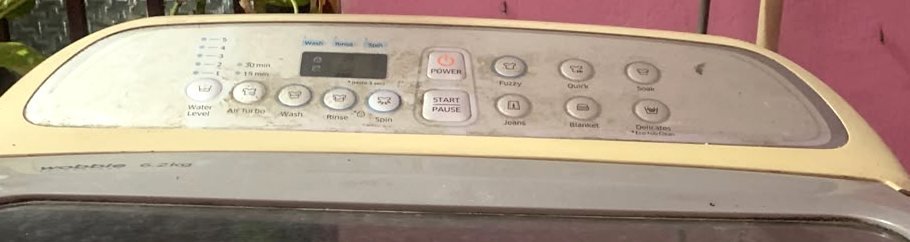
- No spin or rinse hold: look for a spin button or knob set to No Spin, Rinse Hold or 0. These options deliberately leave the clothes wet.
- Gentle programmes: delicate and wool programmes spin slowly, and Bosch says programmes that spin at around 600 rpm won’t remove much water from a large load of hard-wearing clothes (Bosch).
- Preset speeds: Samsung says each programme has a preset spin speed. You can usually pick a slower speed but not a faster one, except on a cotton or dedicated spin programme (Samsung).
- Bedding and bulky items: Whirlpool says to use the Bulky or Sheets/Bedding cycle for these, not Normal or Rapid Wash (Whirlpool).
- Items added late: on Whirlpool models with Add a Garment, adding clothes after the light goes off can limit the maximum spin speed (Whirlpool).
To rescue the load you have now, choose Drain & Spin (or Spin only) at the highest speed the fabric allows.
Check 3: Rebalance the load
An unbalanced load is the most likely cause of all. Bosch calls it “one of the most common causes” and says that when the imbalance is too large, “the spin cycle will not run or reduce its speed to protect your appliance” (Bosch). LG says it happens when “the laundry is piled up on one side of the drum”, and its washers show a UE code (LG).
Loads that commonly cause it:
- One heavy item on its own: Whirlpool says “A single bulky item washing alone can throw the washer drum off balance” (Whirlpool). A bath mat, a pair of jeans or a duvet is a typical culprit.
- Heavy and light items mixed: Beko says uneven loads occur when you mix heavy garments, such as towels, with light ones, like T-shirts (Beko).
- Too few items: Beko says that with only a few items, the machine may not be able to reach its full spin speed (Beko).
- Trainers and shoes: Samsung suggests washing them in a laundry bag together with other clothing (Samsung).
To fix it:
- Pause or cancel the cycle and wait for the door or lid to unlock. Don’t force it.
- Pull the wet items apart and spread them evenly around the drum. LG says to take the laundry out and distribute it evenly (LG).
- Balance a single heavy item with a few towels. Bosch suggests washing large and small items together and closing zips and buttons on duvet covers and pillowcases (Bosch).
- For blankets and padded jackets, LG suggests its Duvet or Sportswear cycle at medium spin, and taking the stuffing out of cushions so you wash only the covers (LG).
- Run Drain & Spin again.
LG advises against machine washing waterproof clothes, which it says may damage the washer (LG).
Check 4: Take some items out
Too much in the drum causes the same problem from the other direction. Samsung says “Overloading prevents effective spinning and can cause the belt to slip on older models” (Samsung), and Whirlpool says an overloaded washer can slow the spin speed and extend cycle times (Whirlpool).
LG says its washers perform best when the load is about two-thirds of the drum capacity (LG). Take out a few bulky items, spread the rest evenly and spin again. Our washing machine maintenance schedule has more on loading.
Check 5: Cut the suds
Whirlpool says using too much detergent, or the wrong type, “can create excess suds that prevent the washer from draining” (Whirlpool), and a washer that can’t drain properly won’t spin. Many machines detect the foam: Whirlpool’s SUD or SD code means the washer has found too many suds, and it runs a routine to clear them that can make the cycle longer (Whirlpool).
- Check the drum: lots of foam left on the clothes or the door glass after the cycle points to this check.
- Use the right detergent: if your washer is a high-efficiency (HE) model, use HE detergent only (Whirlpool).
- Dose for the load: follow the pack for your load size and how dirty it is, and save larger pre-measured pods for large or heavily soiled loads (Whirlpool).
For this load, run a rinse programme with no detergent, then spin. Never add anything to the drum to kill the foam, and never mix cleaning products.
Check 6: Clear the drain hose and pump filter
“Drains but won’t spin” can still be a drain problem. Samsung explains that if the washer can’t drain, “it never moves to the spin step” (Samsung), and a slow drain may not show any error code (Samsung). Beko says a bent or clogged drain hose can disrupt the spin cycle, and a blocked filter “can stop your appliance from spinning” (Beko).
- The hose: unplug the washer, ease it forward and look for kinks, crushing or tight bends, especially where the hose goes into the standpipe or sink (Samsung). Bosch suggests a bucket test: put the hose end in a bucket and run the drain programme. If water won’t flow, or struggles to fill the bucket, the hose or pump is blocked (Bosch).
- Hose too far into the standpipe: Samsung warns that pushing the hose in too deep creates a siphoning effect that causes problems. It says 15 to 20 cm (6 to 8 in) in, not sealed airtight, with the end at least 46 cm (18 in) above the floor (Samsung). Whirlpool’s figures for its top-loaders differ, so check your manual (Whirlpool).
- The pump filter (front-loaders): open the small flap at the bottom front, drain the water into a tray and clear out lint, coins and fluff. Samsung suggests cleaning it about once a month or every 40 washes (Samsung). Our step-by-step guide shows how to clean a washing machine filter without flooding the floor.
- Top-loaders: most have no filter you can open, and the drain hose is harder to reach. Whirlpool says it may be best to call a professional to inspect it (Whirlpool). Never tip a top-loader over to get underneath.
If water stays in the drum, work through washing machine not draining first.
Check 7: Check the door or lid lock
A washer won’t spin unless it knows the door or lid is shut and locked. Whirlpool says that if the door or lid latch isn’t securely closed, “your washer won’t run” (Whirlpool). Beko says to check that nothing is caught in the door and that you hear a locking sound when it closes (Beko).
- Front-loaders: pull any clothing out of the door seal and shut the door firmly until it clicks.
- Top-loaders: a flashing lid lock light can mean the lock hasn’t moved into position or the lid isn’t fully closed because something is in the way. Whirlpool says to check the striker on the lid for interference and wipe away any detergent or lint build-up around the lock with a soft, damp cloth and mild soap (Whirlpool).
If the lock light keeps flashing with nothing in the way, the lock itself may have failed. That’s a job for a technician, not a reason to bypass it.
Check 8: Level it, reset it and test the spin
Level: Whirlpool says a washer that isn’t level can cause an unbalanced load that doesn’t spin properly (Whirlpool). LG says to rock the machine from the front, back and sides, adjust the leg on the side it tips towards with a spanner (wrench), and check the bubble sits in the middle of a spirit level (LG). Our guide to levelling and balancing a washer has the full steps.
Reset: for its motor error codes, Samsung says to switch off at the mains, wait 30 seconds, switch back on and start a new programme (Samsung). Some Samsung models also have a calibration mode that can get the spin working again after a drain problem is fixed (Samsung). The button sequence varies by model, so follow your manual.
Test with the drum empty: take the clothes out and run a short Rinse & Spin with no washing or detergent. Samsung says to watch the drum after it fills (Samsung); LG suggests choosing a high spin speed for this test (LG).
- The empty drum spins: the machine works. The problem is the load, the setting or the suds, so go back to Checks 2 to 5.
- The empty drum doesn’t spin: LG says “If the unit will not spin, service will be required for a proper diagnosis” (LG). With the machine unplugged, Samsung also suggests checking that the empty drum turns freely by hand (Samsung). If it’s stiff or grinds, stop.
When to call a technician
Stop and call a technician if: the empty drum won’t spin on a spin-only programme; the drum won’t turn by hand, or it grinds or clunks; you smell burning or see scorched wiring; the door or lid lock light keeps flashing with nothing in the way; a motor error code comes back after a reset; or the fix means removing panels, the drive belt, motor or control board, or tipping the machine over.
Bosch lists the faults behind a washer that won’t spin even after the checks: “a broken drum or a damaged motor”, “a malfunctioning control board or a worn-out drive belt”, and says “it’s best to seek professional assistance” (Bosch). Beko says it doesn’t recommend repairing the appliance yourself (Beko). If the machine is still under warranty, contact the manufacturer first.
When you book, have the brand, model number and any error code ready, and say which checks you’ve done.
Common questions
Why does my washer drain but not spin?
Usually because the load is off balance or too small, a low-spin or no-spin setting is selected, there are too many suds, or the water drains too slowly for the spin to start. Start with Check 2 and Check 3.
Why are my clothes still soaking wet after the wash?
A gentle programme, a no-spin setting, an off-balance or overloaded drum, or a power cut during the spin. Spread the clothes out and run Drain & Spin, which Whirlpool suggests for removing extra water (Whirlpool).
Can one heavy item stop the spin?
Yes. Whirlpool says a single bulky item washed alone can throw the drum off balance (Whirlpool). Add a few towels to balance it, or use a bulky or duvet programme.
Is it safe to keep re-running the spin?
A couple of tries after rebalancing is reasonable. If the empty drum still won’t spin, stop and book a repair rather than running it over and over.
Could it be the drive belt?
On some machines, yes. Samsung says overloading can make the belt slip on older models (Samsung), and Bosch lists a worn-out drive belt among the faults that need a professional (Bosch). Replacing it means opening the cabinet, so leave it to a technician.
Sources
- What to do if your washing machine is not spinning (Samsung UK)
- Washing machine does not spin at all (Samsung US)
- Washer drum not spinning (LG US)
- How to resolve a UE unbalanced error (LG US)
- Washing machine not spinning (Whirlpool)
- Not spinning: top load washer (Whirlpool)
- Wet clothes at the end of the cycle (Whirlpool)
- Lid lock flashing (Whirlpool)
- What the SUD or SD error code means (Whirlpool)
- Washing machine not spinning (Bosch US)
- Wet clothes (Bosch UK)
- Why is my washing machine not spinning properly? (Beko UK)
Stuck on a step?
Ask below with your appliance's brand and model number, and we'll help if it's safe to fix at home.